Forskning - Studier - Elementærpartikkelfysikk - Hovedoppgaver - HERAB
Beauty Physics at HERA-B
Symmetries play a fundamental role in particle physics. Gauge theories
are based on gauge symmetries. They describe interactions between
particles and allow unification of different forces.
Symmetry invariance implies conservation
of a quantum number. It is the case of U(1) in quantum electrodynamics
(QED) and SU(3)c in quantum chromodynamics (QCD) which lead to
conservation of electric charge and colour charge, respectively.
Symmetries are also a mean of classifying particles.
The Gellman-Nishijima formula 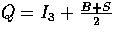 ,
which relates the quantum numbers Q (electric charge), I3 (third
component of isospin), B (baryon number) and S (strangeness), played
a key role in hadron spectroscopy. The SU(2) isospin symmetry could be
extended to SU(3) -flavour and later to SU(3) -colour which lead to the
formulation of QCD, the theory of strong interactions.
Weak interactions, which are based on SU(2) -weak isospin, are special in the
sense that they violate most symmetries.
Non-conservation of strangeness, charm and bottom quantum numbers leads
to quark flavour mixing and
to oscillations in neutral K , D and B meson systems.
Parity, P , charge conjugation, C and time reversal, T , which are also
violated in weak interactions, are of special interest.
CP violation, which is established in the kaon system even if the
effects are small, might play an important role in sheding light on the
mysterious origin of matter-antimatter asymmetry in the universe.
The problems of (i) particle masses - which can be generated by the
so-called Higgs mechanism, currently the weakest point of the standard
model (SM) - (ii) CP -violation and (iii) the number of fermion generations are
closely related. CP violation could only be
accomodated in the standard model with at least 3 fermion generations.
As a member of the third quark family the b -quark, unlike the
t -quark, has a relatively long lifetime. Hadrons containing a b quark
(b -hadrons) can hence be
identified, reconstructed and studied. CP violation is expected to be large in the
b -system because processes involved are of first order.
,
which relates the quantum numbers Q (electric charge), I3 (third
component of isospin), B (baryon number) and S (strangeness), played
a key role in hadron spectroscopy. The SU(2) isospin symmetry could be
extended to SU(3) -flavour and later to SU(3) -colour which lead to the
formulation of QCD, the theory of strong interactions.
Weak interactions, which are based on SU(2) -weak isospin, are special in the
sense that they violate most symmetries.
Non-conservation of strangeness, charm and bottom quantum numbers leads
to quark flavour mixing and
to oscillations in neutral K , D and B meson systems.
Parity, P , charge conjugation, C and time reversal, T , which are also
violated in weak interactions, are of special interest.
CP violation, which is established in the kaon system even if the
effects are small, might play an important role in sheding light on the
mysterious origin of matter-antimatter asymmetry in the universe.
The problems of (i) particle masses - which can be generated by the
so-called Higgs mechanism, currently the weakest point of the standard
model (SM) - (ii) CP -violation and (iii) the number of fermion generations are
closely related. CP violation could only be
accomodated in the standard model with at least 3 fermion generations.
As a member of the third quark family the b -quark, unlike the
t -quark, has a relatively long lifetime. Hadrons containing a b quark
(b -hadrons) can hence be
identified, reconstructed and studied. CP violation is expected to be large in the
b -system because processes involved are of first order.
HERA-B at DESY/Hamburg is one of the experiments that will be able to observe CP
violation in the B meson system and to constrain the parameters of the
quark mass mixing matrix, the Cabbibo-Kobayashi-Maskawa (CKM) matrix,
allowing a test of unitarity, i.e of the
hypothesis of three-quark-generations. Equivalently, one measures three
angles  ,
,  and
and  . If one angle is non-zero it would
mean that CP symmetry is violated. Unitarity requires that the 3 angles
form a triangle, i.e.
. If one angle is non-zero it would
mean that CP symmetry is violated. Unitarity requires that the 3 angles
form a triangle, i.e. 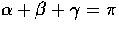 .
.
Bottom production at HERA-B proceeds via gluon-gluon fusion:  . A few times 108
  pairs are expected per
year, making it possible to study various exclusive decay channels of b
mesons and baryons. The
pairs are expected per
year, making it possible to study various exclusive decay channels of b
mesons and baryons. The  production cross section is a factor 1000
higher and allows detailed studies of D mesons.
production cross section is a factor 1000
higher and allows detailed studies of D mesons.  oscillations, CP violation in the D system and rare D decays can
be addressed.
oscillations, CP violation in the D system and rare D decays can
be addressed.
The HERA-B detector is an experimental challenge as it is based on modern technology developed for LHC. The data acquisition, online monitoring and trigger systems have to cope with high rates comparable to the LHC environment. HERA-B is, hence, a necessary input to future hadronic experiments, like ATLAS. The software tools, tagging and analysis techniques will help prepare for LHC physics. Last but not least, the B physics programme at LHC will be a natural continuation of the HERA-B efforts.
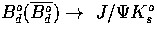
As the detector has been commissioned and data taking is about to start, we would like to suggest the following topics:
 ,
,  (
( ) ,
) , 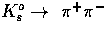 . The goal is to measure the
asymmetry between Bod and
. The goal is to measure the
asymmetry between Bod and  decays, which is
directly proportional to
decays, which is
directly proportional to  . Large CP violation asymmetries
are expected.
. Large CP violation asymmetries
are expected.
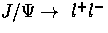
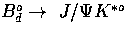 , ,
, ,  . This channel does not present any
asymmetry and allows good control and normalisation of the above reaction,
as the kinematics are similar.
. This channel does not present any
asymmetry and allows good control and normalisation of the above reaction,
as the kinematics are similar.
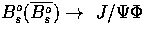 , () ,
  . The goal is to measure the
asymmetry between Bos and
. The goal is to measure the
asymmetry between Bos and  decays. Very small CP
asymmetries are expected in the standard model, such that any large measured
numbers would mean new physics, beyond the SM.
decays. Very small CP
asymmetries are expected in the standard model, such that any large measured
numbers would mean new physics, beyond the SM.
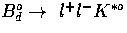 ,
,
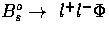 . Current experimental upper limits are close to
the theoretical predictions, such that signals are expected at HERA-B.
These flavour changing neutral currents (FCNC) are suppressed in the
standard mode, and are sensitive to physics beyond the SM,
such as supersymmetry. Lepton Family Violating decays like
. Current experimental upper limits are close to
the theoretical predictions, such that signals are expected at HERA-B.
These flavour changing neutral currents (FCNC) are suppressed in the
standard mode, and are sensitive to physics beyond the SM,
such as supersymmetry. Lepton Family Violating decays like  are strictly forbidden in the
SM and any observation would mean onset of new physics.
are strictly forbidden in the
SM and any observation would mean onset of new physics.
 are interesting
because (i) they would allow the determination of the angles
and and (ii) the interpretation of the data requires more
theoretical inputs. This study and the above one are well suited to a
theoretician who would like to do some phenomenology.
are interesting
because (i) they would allow the determination of the angles
and and (ii) the interpretation of the data requires more
theoretical inputs. This study and the above one are well suited to a
theoretician who would like to do some phenomenology.
As the HERA-B experiment is located at DESY in Hamburg, it is possible for candidates to travel in order to know the experiment and take advantage of the local expertise.
You can take a look at a list of possible topics for Cand. Scient and Dr. Scient studies.
For any further information, please contact Torleiv Buran or Farid Ould-Saada.